Artist Statement
Demitra Agouras
I am a material driven artist working with textiles and installations located in Melbourne. My work capturing, preserving, and re-contextualising of women’s domestic craft traditions as enduring narratives and living archives. Through using second-hand domestic textiles, I am reclaiming the delicate, discarded, and handmade in a form of preservation. My work aims to eternalise the value of women’s work through translating the materials into new forms of pattern and light.
My work explores arts and craft traditions that are associated with women’s domestic arts. I have a primary concentration on the use of antique and found materials, as well as the act of sourcing these old textiles from second hand stores. A fundamental part of these textiles is eternalising the history that they carry unveiling layers of, meaning, memory and belonging.
Through these rich materials histories I am exploring their re-construction and breathing new life into them by bringing their original beauty to the foreground and accentuating their craftsmanship. By working with materials of lace, doilies and embroidered linen I am highlighting the remnants of domestic life and am paying homage to women’s labour and the meticulous care woven into the handmade pieces. I am drawn to their fragility and beauty but also their displacement thought time. These once treasured materials are now easily discarded and forgotten. Through sourcing and incorporating them into my practice I aim to honour their craftsmanship and the invisible narrative that they carry. Reimagining these craft-based traditions within a contemporary frame allows me to preserve the ephemerality of these textiles.
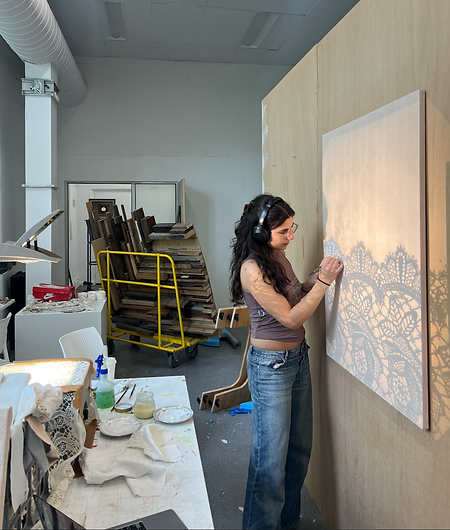
Recontextualising these materials through capturing its patterns and detail is central in transforming the textiles. By stepping away from the physical archive I am able to shift the focus from these art and craft based traditional into a contemporary sphere. By translating patterns into paint or isolating elements through mark making I am magnifying their details. It’s preserving the original presence that’s embed in the pattern and translating it into a new visual language where the object can be eternalised. It starts to become about the disruption of the original materials and how it’s allowed to be translated and preserved to create a new space where the past and present converge. It creates a dialogue between the value of these objects that has been confined to the domestic sphere which acts as a quiet resistance against the erasure of this craft and women labour. It becomes a mode of storytelling about reclaiming these discarded narratives and eternalising the overlooked.